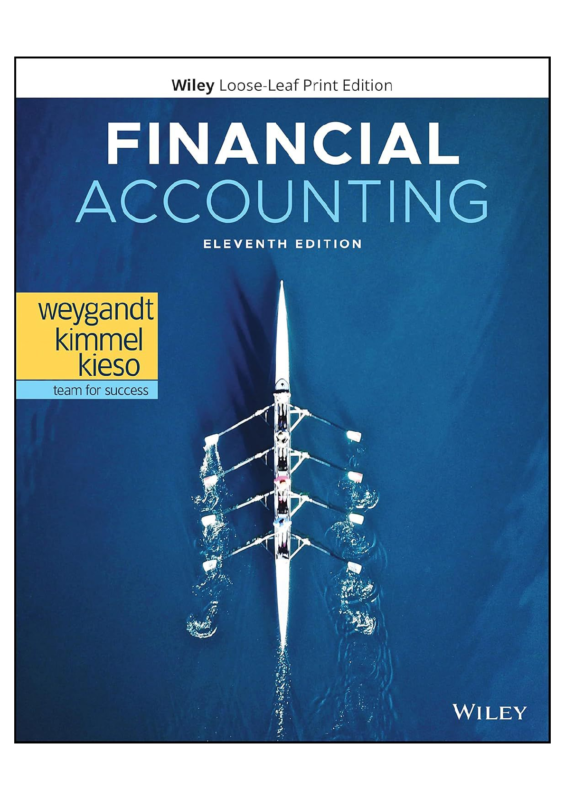
Solutions manual for Financial Accounting, 11th Edition by Jerry J. Weygandt, Paul D. Kimmel, and Donald E. Kieso
$23.00
Secure checkout
Instant digital download
PDF document
Document details
- Pages
- 962
- File size
- 6.61 MB
- Format
- Digital PDF
- Course
- Accounting
- Category
- SOLUTIONS MANUAL
Sign in or create a free account to continue. Your purchase will be saved in My Downloads.
About this ebook
Solutions manual for Financial Accounting, 11th Edition by Jerry J. Weygandt, Paul D. Kimmel, and Donald E. Kieso covers 13 core chapters that guide students through the fundamental accounting cycle, asset and liability management, equity transactions, and corporate financial statement analysis. [1, 2]
The textbook layout balances accounting mechanics with modern business practices, featuring integrated data analytics and current FASB standard updates. [1, 2]
🗒 Detailed Chapter-by-Chapter Topics
Chapter 1: Accounting in Action
- Purpose and users of accounting information.
- The building blocks of accounting (ethics, principles, and assumptions).
- The foundational accounting equation: Assets = Liabilities + Stockholders' Equity.
- Analysis of basic business transactions.
- Preparation of the four primary financial statements. [1, 2, 3, 4]
Chapter 2: The Recording Process
- The concept of accounts, debits, and credits.
- The journalizing process and entering transactions in the General Journal.
- Posting transactions to the Ledger (T-accounts).
- Preparation of the initial Trial Balance. [1, 2]
Chapter 3: Adjusting the Accounts
- Accrual-basis versus cash-basis accounting.
- The timing concept and the necessity of adjusting entries.
- Deferrals (prepaid expenses and unearned revenues).
- Accruals (accrued revenues and accrued expenses).
- Preparation of the Adjusted Trial Balance. [1, 2, 3]
Chapter 4: Completing the Accounting Cycle
- Using and preparing a closing worksheet.
- Journalizing and posting closing entries (closing temporary accounts).
- Preparing a Post-Closing Trial Balance.
- Reversing and correcting entries (optional cycle steps).
- Classified Balance Sheet presentation (current vs. non-current items). [1, 2, 3]
Chapter 5: Accounting for Merchandising Operations
- Merchandising operations and the operating cycle.
- Recording purchases and sales under a perpetual inventory system.
- Recording transactions under a periodic inventory system.
- The multi-step Income Statement layout and gross profit calculation. [1]
Chapter 6: Inventories
- Inventory classifications and taking a physical inventory count.
- Inventory cost flow assumptions: Specific Identification, FIFO, LIFO, and Average-Cost.
- Financial statement effects of cost flow methods and inventory errors.
- Lower-of-Cost-or-Net Realizable Value (LCNRV) inventory valuation. [1, 2]
File included
Solution-manual-for-Financial-Accounting-11th-Edition-by-Jerry-J.-Weygandt.pdf
6.61 MB
Related ebooks