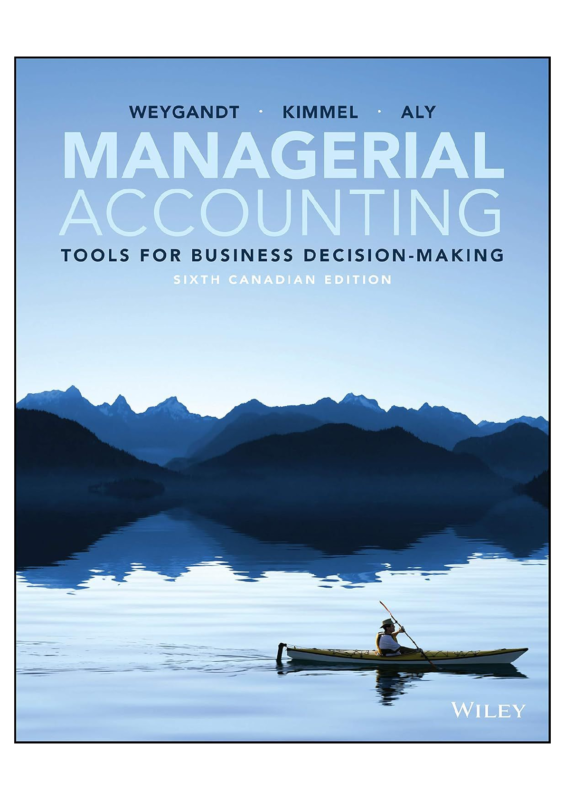
Solutions manual for Managerial Accounting: Tools for Business Decision-Making 6th Canadian Edition by Jerry J. Weygandt, Paul D. Kimmel, and Ibrahim M. Aly
$23.00
Secure checkout
Instant digital download
PDF document
Document details
- Pages
- 1,088
- File size
- 7.04 MB
- Format
- Digital PDF
- Course
- Accounting
- Category
- SOLUTIONS MANUAL
Sign in or create a free account to continue. Your purchase will be saved in My Downloads.
About this ebook
The Solutions manual for Managerial Accounting: Tools for Business Decision-Making 6th Canadian Edition by Jerry J. Weygandt, Paul D. Kimmel, and Ibrahim M. Aly covers the fundamental concepts of cost accounting, planning, control, and strategic decision-making. [1, 2, 3, 4, 5]
The curriculum is structured around four primary operational themes:
Cost Accumulation and Product Costing
-
- Managerial Accounting Basics: Comparing financial and managerial accounting, manufacturing costs (direct materials, direct labour, manufacturing overhead), and financial statement preparation for manufacturers. [1]
- Job Order Costing: Tracking costs for specific, unique jobs or batches using job cost sheets. [1]
- Process Costing: Assigning costs to continuous, mass-produced processes using equivalent units of production. [1]
- Activity-Based Costing (ABC): Allocating overhead costs more accurately based on activities and cost drivers rather than traditional single volume-based rates. [1, 3]
Decision-Making Concepts
-
- Cost-Volume-Profit (CVP) Analysis: Exploring cost behavior (fixed vs. variable costs), contribution margin, break-even point analysis, and target net income.
- Incremental Analysis: Evaluating special business choices like whether to accept special orders, make or buy components, sell or process further, or repair/retain equipment.
- Pricing Strategies: Reviewing target costing, cost-plus pricing, and time-and-material pricing configurations.
- Alternative Inventory Costing Methods: Comparing absorption costing with variable (marginal) costing for internal management reporting. [1, 3, 4, 5]
Planning and Control
-
- Budgetary Planning: Developing a master budget, including sales, production, direct materials, cash, and budgeted financial statements.
- Budgetary Control and Responsibility Accounting: Evaluating performance using static and flexible budgets alongside decentralized cost, profit, and investment centers.
- Standard Costs and Variances: Setting standard costs and computing variances for direct materials, direct labour, and overhead.
- Balanced Scorecard: Integrating financial and non-financial metrics across customer, internal process, and learning viewpoints. [, 2, 3]
Long-Term Planning and Financial Analysis
- Capital Investments: Evaluating long-term assets using cash payback, net present value (NPV), internal rate of return (IRR), and annual rate of return.
- Statement of Cash Flows: Preparing and analyzing cash inflows and outflows across operating, investing, and financing business operations.
- Financial Statement Analysis: Utilizing horizontal, vertical, and ratio analyses to assess general business performance. [1, 3]
File included
Solution-manual-for-Managerial-Accounting-6e-Canadian-Weygandt.pdf
7.04 MB
Related ebooks