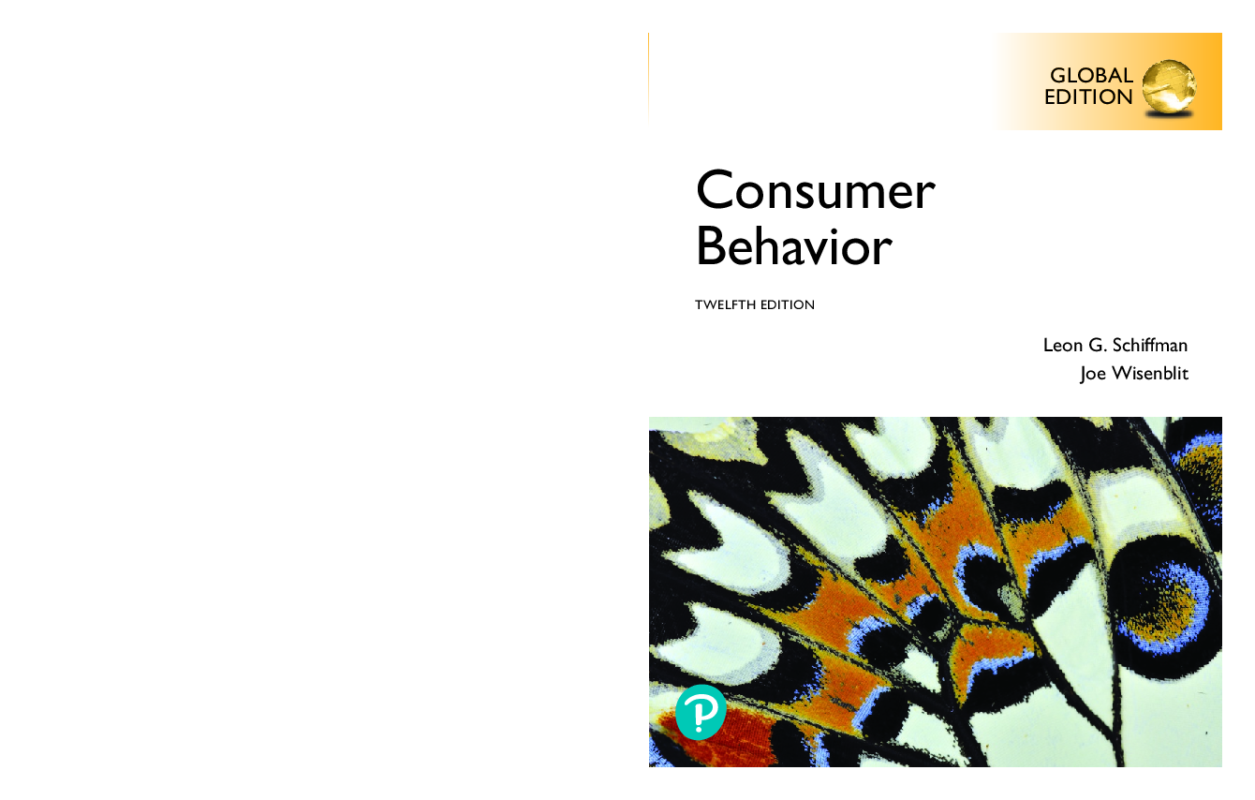
Consumer Behavior 12th Global Edition By Leon Schiffman, Joseph L. Wisenblit
$30.00
Secure checkout
Instant digital download
PDF document
Document details
- Pages
- 509
- File size
- 24.55 MB
- Format
- Digital PDF
- Course
- Consumer Behaviour
- Category
- eBook[PDF]
Sign in or create a free account to continue. Your purchase will be saved in My Downloads.
About this ebook
Consumer Behavior 12th Global Edition By Leon Schiffman, Joseph L. Wisenblit contains a highly structured, chapter-by-chapter summary of the core theoretical frameworks from Leon Schiffman and Joseph L. Wisenblit's Consumer Behavior, 12th Global Edition. [1]
📑 Summary Overview of Included Key Frameworks
- Chapter 1: Technology-Driven Consumer Behavior
- The Marketing Concept Matrix: Formulates customer value, satisfaction, and retention.
- STP Linkages: Connects primary/secondary consumer research to segmentation, targeting, and positioning.
- Chapter 2: Market Segmentation & Strategic Targeting
- Chapter 3: Consumer Motivation & Personality
- Maslow's Hierarchy & Trio of Needs: Analyzes biological and psychological drivers (Power, Affiliation, Achievement).
- Brand Personality Matrix: Connects human characteristics (e.g., Sincerity, Ruggedness) to commercial entities.
- Chapter 4: Consumer Perception
- Sensory Thresholds: Charts Absolute Threshold, Differential Threshold, and Weber's Law.
- Gestalt Principles: Explains perceptual selection, organization (Figure-and-Ground), and interpretation biases.
- Chapter 5: Consumer Learning
- Chapter 6: Consumer Attitude Formation & Change
- Tricomponent Attitude Model: The foundational ABC framework—Affective (feelings), Behavioral/Conative (intentions), and Cognitive (beliefs).
- Elaboration Likelihood Model (ELM): Details Central vs. Peripheral persuasion routes.
- Chapter 7: Persuading Consumers
- Source Credibility Matrix: Breaks down consumer trust, expertise, and the Sleeper Effect.
- Message Framing: Contours positive gains vs. negative loss avoidance structures.
- Chapters 8 & 9: Social, Mobile Media, Reference Groups & WOM
- Media Ecosystem: Coordinates Owned, Paid, and Earned media networks.
- Reference Typology: Groups consumers by Membership, Aspirational, and Dissociative associations. [1]
- Chapter 10: The Family & Its Social Standing
- Chapters 11, 12 & 13: Cultural and Cross-Cultural Frameworks
- Enculturation vs. Acculturation: Explains internalizing native vs. foreign cultural values.
- Standardization vs. Localization: Evaluates global scale vs. hyper-local customization strategies.
- Chapter 14: Consumer Decision-Making & New Product Diffusion
- The Schiffman-Wisenblit Decision Model: Breaks down the complete Input, Process, and Output stages.
- Diffusion of Innovations: Categorizes consumers from Innovators (2.5%) through Laggards (16%) based on product trait reception (relative advantage, compatibility, trialability).
- Chapter 15: Marketing Ethics & Social Responsibility
File included
eBook-PDF-Consumer-Behavior-12th-Global-Edition-By-Leon-Schiffman-Joseph-L.-Wisenblit.pdf
24.55 MB
Related ebooks