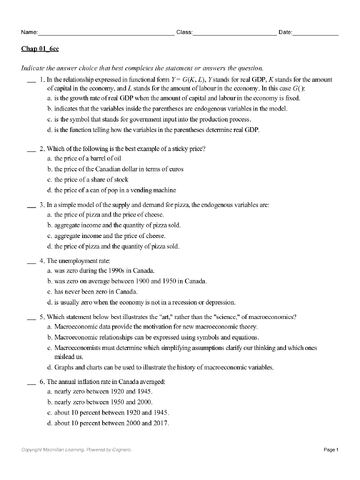
Test Bank for Macroeconomics, 6th Canadian Edition by Gregory Mankiw, William Scarth
$29.00
Secure checkout
Instant digital download
PDF document
Document details
- Pages
- 528
- File size
- 6.79 MB
- Format
- Digital PDF
- Course
- Economics
- Category
- TEST BANKS
Sign in or create a free account to continue. Your purchase will be saved in My Downloads.
About this ebook
Test Bank for Macroeconomics, 6th Canadian Edition, 6ce by N. Gregory Mankiw,William M. Scarth TEST BANK
ISBN-13: 9781319115593
Full chapters included
Part I Introduction
Chapter 1 The Science of Macroeconomics
1-1 What Macroeconomists Study
1-2 How Economists Think
Theory as Model Building
The Use of Multiple Models
Prices: Flexible Versus Sticky
Microeconomic Thinking and Macroeconomic Models
1-3 How This Book Proceeds
Quick Quiz
Summary
Key Concepts
Questions for Review
Problems and Applications
Answers to Quick Quiz
Chapter 2 The Data of Macroeconomics
2-1 Measuring the Value of Economic Activity: Gross Domestic Product
Income, Expenditure, and the Circular Flow
Rules for Computing GDP
Real GDP Versus Nominal GDP
The GDP Deflator
Chain-Weighted Measures of Real GDP
The Components of Expenditure
Other Measures of Income
Seasonal Adjustment
2-2 Measuring the Cost of Living: The Consumer Price Index
The Price of a Basket of Goods
How the CPI Compares to the GDP Deflator
Difficulties in Measuring Inflation
2-3 Measuring Joblessness: The Unemployment Rate
The Labour Force Survey
Survey of Employment, Payrolls, and Hours
2-4 Conclusion: From Economic Statistics to Economic Models
Part II Classical Theory: The Economy in the Long Run
Chapter 3 National Income: Where It Comes From and Where It Goes
3-1 What Determines the Total Production of Goods and Services?
The Factors of Production
The Production Function
The Supply of Goods and Services
3-2 How Is National Income Distributed to the Factors of Production?
Factor Prices
The Decisions Facing a Competitive Firm
The Firm’s Demand for Factors
The Division of National Income
The Cobb–Douglas Production Function
3-3 What Determines the Demand for Goods and Services?
Consumption
Investment
Government Purchases
3-4 What Brings the Supply and Demand for Goods and Services into Equilibrium?
Equilibrium in the Market for Goods and Services: The Supply and Demand for the Economy’s Output
Equilibrium in the Financial Markets: The Supply and Demand for Loanable Funds
Changes in Saving: The Effects of Fiscal Policy
Changes in Investment Demand
3-5 Conclusion
Chapter 4 The Monetary System: What It Is and How It Works
4-1 What Is Money?
The Functions of Money
The Types of Money
The Development of Fiat Money
How the Quantity of Money Is Controlled
How the Quantity of Money Is Measured
4-2 The Role of Banks in the Monetary System
100-Percent-Reserve Banking
Fractional-Reserve Banking
Bank Capital, Leverage, and Capital Requirements
4-3 How Central Banks Influence the Money Supply
A Model of the Money Supply
The Instruments of Monetary Policy
4-4 Conclusion
Chapter 5 Inflation: Its Causes, Effects, and Social Costs
5-1 The Quantity Theory of Money
Transactions and the Quantity Equation
From Transactions to Income
The Money Demand Function and the Quantity Equation
The Assumption of Constant Velocity
Money, Prices, and Inflation
5-2 Seigniorage: The Revenue from Printing Money
5-3 Inflation and Interest Rates
Two Interest Rates: Real and Nominal
The Fisher Effect
Two Real Interest Rates: Ex Ante and Ex Post
5-4 The Nominal Interest Rate and the Demand for Money
The Cost of Holding Money
Future Money and Current Prices
5-5 The Social Costs of Inflation
The Layman’s View and the Classical Response
The Costs of Expected Inflation
The Costs of Unexpected Inflation
One Benefit of Inflation
5-6 Hyperinflation
The Costs of Hyperinflation
The Causes of Hyperinflation
5-7 Conclusion: The Classical Dichotomy
Chapter 6 The Open Economy
6-1 The International Flows of Capital and Goods
The Role of Net Exports
International Capital Flows and the Trade Balance
International Flows of Goods and Capital: An Example
The Irrelevance of Bilateral Trade Balances
6-2 Saving and Investment in a Small Open Economy
Capital Mobility and the World Interest Rate
The Model
How Policies Influence the Trade Balance
Evaluating Economic Policy
6-3 Exchange Rates
Nominal and Real Exchange Rates
The Real Exchange Rate and the Trade Balance
The Determinants of the Real Exchange Rate
How Policies Influence the Real Exchange Rate
The Effects of Trade Policies
The Determinants of the Nominal Exchange Rate
The Special Case of Purchasing-Power Parity
6-4 Conclusion: The United States as a Large Open Economy
Appendix: The Open Economy in the Very Long Run
Foreign Debt
Fiscal Policy
Trickle-Down Economics
Trump’s Tax Changes and Canadian Incomes
Chapter 7 Unemployment and the Labour Market
7-1 Job Loss, Job Finding, and the Natural Rate of Unemployment
7-2 Job Search and Frictional Unemployment
Causes of Frictional Unemployment
Public Policy and Frictional Unemployment
7-3 Real-Wage Rigidity and Structural Unemployment
Minimum-Wage Laws
Unions and Collective Bargaining
Efficiency Wages
7-4 Labour Market Experience: Canada
The Duration of Unemployment
Variation in the Unemployment Rate Across Age Groups and Regions
Trends in Unemployment
Transitions into and out of the Labour Force
7-5 Labour-Market Experience: Europe
The Rise in European Unemployment
Unemployment Variation Within Europe
The Rise of European Leisure
7-6 Conclusion
Appendix: Unemployment, Inequality, and Government Policy
More Generous EI
Canada Worker Benefit (CWB)
An Employer Subsidy for Hiring Low-Skilled Individuals
Summing Up
More Problems and Applications
Part III Growth Theory: The Economy in the Very Long Run
Chapter 8 Economic Growth I: Capital Accumulation and Population Growth
8-1 The Accumulation of Capital
The Supply and Demand for Goods
Growth in the Capital Stock and the Steady State
Approaching the Steady State: A Numerical Example
How Saving Affects Growth
8-2 The Golden Rule Level of Capital
Comparing Steady States
Finding the Golden Rule Steady State: A Numerical Example
The Transition to the Golden Rule Steady State
8-3 Population Growth
The Steady State with Population Growth
The Effects of Population Growth
Alternative Perspectives on Population Growth
8-4 Conclusion
Chapter 9 Economic Growth II: Technology, Empirics, and Policy
9-1 Technological Progress in the Solow Model
The Efficiency of Labour
The Steady State with Technological Progress
The Effects of Technological Progress
9-2 From Growth Theory to Growth Empirics
Balanced Growth
Convergence
Factor Accumulation versus Production Efficiency
9-3 Policies to Promote Growth
Evaluating the Rate of Saving
Changing the Rate of Saving
Allocating the Economy’s Investment
Establishing the Right Institutions
Supporting a Pro-growth Culture
Encouraging Technological Progress
9-4 Beyond the Solow Model: Endogenous Growth Theory
The Basic Model
A Two-Sector Model
The Microeconomics of Research and Development
The Process of Creative Destruction
Limits to Growth
9-5 Conclusion
Appendix: Accounting for the Sources of Economic Growth
Increases in the Factors of Production
Increases in Capital
Increases in Labour
Increases in Capital and Labour
Technological Progress
The Sources of Growth in Canada
The Solow Residual in the Short Run
Part IV Business Cycle Theory: The Economy in the Short Run
Chapter 10 Introduction to Economic Fluctuations
10-1 The Facts About the Business Cycle
GDP and Its Components
Unemployment, GDP, and Okun’s Law
Leading Economic Indicators
10-2 Time Horizons in Macroeconomics
How the Short Run and the Long Run Differ
The Model of Aggregate Supply and Aggregate Demand
10-3 Aggregate Demand
The Quantity Equation as Aggregate Demand
Why the Aggregate Demand Curve Slopes Downward
Shifts in the Aggregate Demand Curve
10-4 Aggregate Supply
The Long Run: The Vertical Aggregate Supply Curve
The Short Run: The Horizontal Aggregate Supply Curve
From the Short Run to the Long Run
10-5 Stabilization Policy
Shocks to Aggregate Demand
Shocks to Aggregate Supply
10-6 Conclusion
Chapter 11 Aggregate Demand I: Building the IS–LM Model
11-1 The Goods Market and the IS Curve
The Keynesian Cross
The Interest Rate, Investment, and the IS Curve
How Fiscal Policy Shifts the IS Curve
11-2 The Money Market and the LM Curve
The Theory of Liquidity Preference
Income, Money Demand, and the LM Curve
How Monetary Policy Shifts the LM Curve
11-3 Conclusion: The Short-Run Equilibrium
Chapter 12 Aggregate Demand II: Applying the IS–LM Model
12-1 Explaining Fluctuations with the IS–LM Model
How Fiscal Policy Shifts the IS Curve and Changes the Short-Run Equilibrium
How Monetary Policy Shifts the LM Curve and Changes the Short-Run Equilibrium
The Interaction Between Monetary and Fiscal Policy
Shocks in the IS–LM Model
What Is the Bank of Canada’s Policy Instrument—the Money Supply or the Interest Rate? And What Is Quantitative Easing?
12-2 IS–LM as a Theory of Aggregate Demand
From the IS–LM Model to the Aggregate Demand Curve
The IS–LM Model in the Short Run and Long Run
12-3 The Great Depression
The Spending Hypothesis: Shocks to the IS Curve
The Money Hypothesis: A Shock to the LM Curve
The Money Hypothesis Again: The Effects of Falling Prices
Could the Depression Happen Again?
The Liquidity Trap (Also Known as the Zero Lower Bound)
12-4 Conclusion
Appendix: Aggregate Demand Theory Without the LM Curve
Aggregate Demand in a Closed Economy
Aggregate Demand in a Small Open Economy
Chapter 13 The Open Economy Revisited: The Mundell–Fleming Model and the Exchange-Rate Regime
13-1 The Mundell–Fleming Model
The Key Assumption: Small Open Economy with Perfect Capital Mobility
The Goods Market and the IS* Curve
The Money Market and the LM* Curve
Putting the Pieces Together
13-2 The Small Open Economy Under Floating Exchange Rates
Monetary Policy
Trade Policy
World Interest-Rate Changes
13-3 The Small Open Economy Under Fixed Exchange Rates
How a Fixed-Exchange-Rate System Works
13-4 World Interest-Rate Changes
Policy in the Mundell–Fleming Model: A Summary
13-5 Interest Rate Differentials
Country Risk and Exchange-Rate Expectations
Differentials in the Mundell–Fleming Model
13-6 Should Exchange Rates Be Floating or Fixed?
Pros and Cons of Different Exchange-Rate Systems
Speculative Attacks, Currency Boards, and Dollarization
The Impossible Trinity
13-7 From the Short Run to the Long Run: The Mundell–Fleming Model with a Changing Price Level
13-8 A Concluding Reminder
Appendix: Extensions to the Mundell–Fleming Model
The Exchange Rate and the CPI
Flexible Domestic Prices
Exchange-Rate Expectations
An Attempt at Perspective
Chapter 14 Aggregate Supply and the Short-Run Tradeoff Between Inflation and Unemployment
14-1 The Basic Theory of Aggregate Supply
The Sticky-Price Model
An Alternative Theory: The Imperfect-Information Model
Implications
14-2 Inflation, Unemployment, and the Phillips Curve
Deriving the Phillips Curve from the Aggregate Supply Curve
Adaptive Expectations and Inflation Inertia
Two Causes of Rising and Falling Inflation
The Short-Run Tradeoff Between Inflation and Unemployment
Disinflation and the Sacrifice Ratio
Rational Expectations and the Possibility of Painless Disinflation
Challenges to the Natural-Rate Hypothesis
14-3 Conclusion
Appendix: A Big, Comprehensive Model
Special Case 1: The Classical Closed Economy
Special Case 2: The Classical Small Open Economy
Special Case 3: The Basic Model of Aggregate Demand and Aggregate Supply
Special Case 4: The IS–LM Model
Special Case 5: The Mundell–Fleming Model with a Floating Exchange Rate
Special Case 6: The Mundell–Fleming Model with a Fixed Exchange Rate
Part V Topics in Macroeconomic Theory and Policy
Chapter 15 A Dynamic Model of Economic Fluctuations
15-1 Elements of the Model
Output: The Demand for Goods and Services
The Real Interest Rate: The Fisher Equation
Inflation: The Phillips Curve
Expected Inflation: Adaptive Expectations
The Nominal Interest Rate: The Monetary-Policy Rule
15-2 Solving the Model
The Long-Run Equilibrium
The Dynamic Aggregate Supply Curve
The Dynamic Aggregate Demand Curve
The Short-Run Equilibrium
15-3 Using the Model
Long-Run Growth
A Shock to Aggregate Supply
A Shock to Aggregate Demand
A Shift in Monetary Policy
15-4 Two Applications: Lessons for Monetary Policy
The Tradeoff Between Output Variability and Inflation Variability
The Taylor Principle
15-5 Conclusion: Toward DSGE Models
Chapter 16 Alternative Perspectives on Stabilization Policy
16-1 Should Policy Be Active or Passive?
Lags in the Implementation and Effects of Policies
The Difficult Job of Economic Forecasting
Ignorance, Expectations, and the Lucas Critique
The Historical Record
16-2 Should Policy Be Conducted by Rule or Discretion?
Distrust of Policymakers and the Political Process
The Time Inconsistency of Discretionary Policy
Rules for Monetary Policy
16-3 Conclusion
Appendix: Time Inconsistency and the Tradeoff Between Inflation and Unemployment
Chapter 17 Government Debt and Budget Deficits
17-1 The Size of the Government Debt
17-2 Measurement Problems
Problem 1: Inflation
Problem 2: Capital Assets
Problem 3: Uncounted Liabilities
Problem 4: The Business Cycle
17-3 The Traditional View of Government Debt
17-4 The Ricardian View of Government Debt
The Basic Logic of Ricardian Equivalence
Consumers and Future Taxes
Making a Choice
17-5 Other Perspectives on Government Debt
Balanced Budgets Versus Optimal Fiscal Policy
Fiscal Effects on Monetary Policy
Debt and the Political Process
International Dimensions
17-6 Conclusion
Appendix: Estimating the Benefits of Deficit and Debt Reduction
Chapter 18 The Financial System: Opportunities and Dangers
18-1 What Does the Financial System Do?
Financing Investment
Sharing Risk
Dealing with Asymmetric Information
Fostering Economic Growth
18-2 Financial Crises
The Anatomy of a Crisis
Policy Responses to a Crisis
Policies to Prevent Crises
18-3 Conclusion
Chapter 19 The Microfoundations of Consumption and Investment
19-1 What Determines Consumer Spending?
John Maynard Keynes and the Consumption Function
Franco Modigliani and the Life-Cycle Hypothesis
Milton Friedman and the Permanent-Income Hypothesis
Robert Hall and the Random-Walk Hypothesis
David Laibson and the Pull of Instant Gratification
The Bottom Line on Consumption
19-2 What Determines Investment Spending?
The Rental Price of Capital
The Cost of Capital
The Cost-Benefit Calculus of Investment
Taxes and Investment
The Stock Market and Tobin’s q
Financing Constraints
Banking Crises and Credit Crunches
The Botto
File included
Mankiw.pdf
6.79 MB
Related ebooks