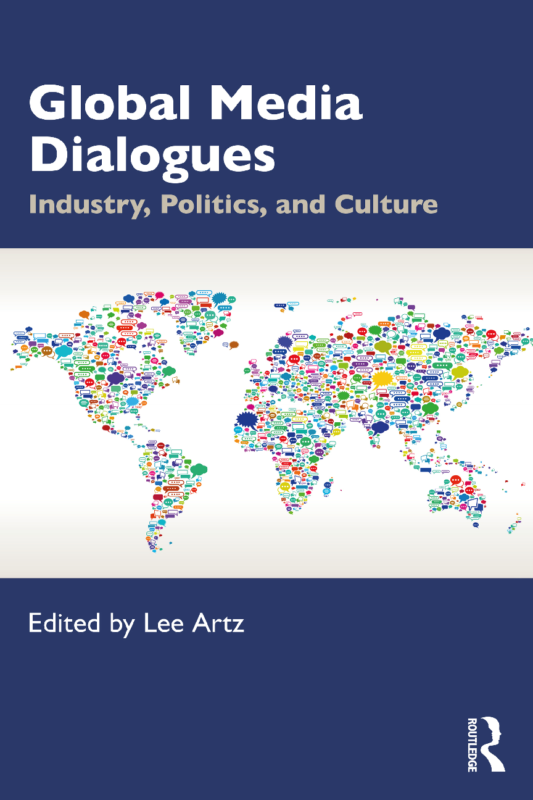
Global Media Dialogues: Industry, Politics, and Culture By Lee Artz
$30.00
Secure checkout
Instant digital download
PDF document
Document details
- Pages
- 272
- File size
- 5.49 MB
- Format
- Digital PDF
- Course
- Social Sciences
- Category
- eBook[PDF]
Sign in or create a free account to continue. Your purchase will be saved in My Downloads.
About this ebook
Global Media Dialogues: Industry, Politics, and Culture (2023), edited by Lee Artz, is an academic volume that brings together leading media scholars to analyze the shifts, continuities, and conflicts within contemporary international mass communication. [1, 2, 3]
The book approaches global media through the lenses of international political economy, cultural studies, and class analysis. It is structured around several critical core themes and regional case studies: [1]
1. The Political Economy of Transnational Media
- Corporate Consolidation: Investigation into how mega-mergers, acquisitions, and joint ventures (such as Disney, Sony, Warner, India's Reliance, and China's Dalian Wanda) lock global media into a tight, capital-driven circle. [1]
- Neoliberal Ideology: Analysis of how the global media system champions neoliberal values, pushing for privatization, deregulation, commercialization, and austerity. [1]
- Class Relations and Access: Exploration of how global class structures dictate media control, contrasting the immense power of the capitalist and professional middle classes with the lack of media production access for the global working class. [1]
2. Media Imperialism vs. Transnationalism
- The Imperialism Debate: A central dialogue led by scholars like Oliver Boyd-Barrett and Tanner Mirrlees reviewing whether Western cultural imperialism still dominates the world or if it is shifting into a decentralized, transnational model. [, 2]
- Transnational Collaboration: Examination of how modern film and television co-productions cross traditional national borders, creating a shared media culture that seemingly transcends distinct local identities. [1]
- Global Production Hubs: How major media capitals (such as Miami for Hispanic media, Mumbai for South Asian media, and Cairo for Arab media) rely on tentacled service networks in peripheral cities to extract profit and distribute content. [1]
3. Media, Power, and Culture in the Global South
- South Asia as Contested Terrain: Case studies highlighting India's market dominance over South Asian viewership and the rise of local Over-The-Top (OTT) streaming platforms acting as a shield against purely Western streaming services. [1]
- Chinese Media Expansion: The growing footprint of Chinese media in Africa (e.g., StarTimes networks in countries like Tanzania, Kenya, and Uganda), looking at how individualist themes in Chinese TV dramas subtly shape local class perceptions and values. [1]
- Geopolitical Interplay: How local protectionism, national media dependencies, and regional political tensions (such as India banning Chinese apps alongside growing U.S. partnerships) shape contemporary media consumption. [1]
4. Resistance and Social Movements
- Counter-Hegemony: Reframing traditional class struggles within modern grassroots social movements.
- Democratic Communication: Evaluation of how alternative media tools are utilized by global citizens fighting for equality, human rights, democracy, and environmental defense to counteract corporate propaganda. [1, 2, 3]
File included
tmpphp9OaPAJ
5.49 MB
Related ebooks