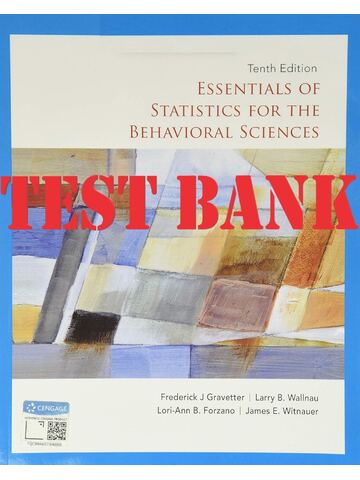
Test Bank for Essentials of Statistics for the Behavioral Sciences, 10th Edition By Frederick Gravetter, Larry Wallnau, Lori-Ann Forzano, James Witnauer
$26.00
Secure checkout
Instant digital download
PDF document
Document details
- Pages
- 329
- File size
- 2.39 MB
- Format
- Digital PDF
- Course
- Psychology
- Category
- TEST BANKS
Sign in or create a free account to continue. Your purchase will be saved in My Downloads.
About this ebook
The Test Bank for 10th Edition of Essentials of Statistics for the Behavioral Sciences by Frederick Gravetter, Larry Wallnau, Lori-Ann B. Forzano, and James E. Witnauer is structured into 15 core chapters. The text transitions from fundamental descriptive frameworks into complex inferential statistical tools tailored for social science research. [1, 2]
The complete breakdown of topics covered chapter-by-chapter includes:
Part 1: Introduction and Descriptive Statistics
- Chapter 1: Introduction to Statistics – Research methods, populations versus samples, variables, scales of measurement, and basic math/statistical notations. [1, 2]
- Chapter 2: Frequency Distributions – Organizing raw data into tables, frequency distribution graphs (histograms, polygons, bar graphs), shape profiles, and percentiles. [1, 2]
- Chapter 3: Central Tendency – Calculating, identifying, and choosing between the mean, median, and mode depending on data distribution shape. [1, 2, 3, 4]
- Chapter 4: Variability – Measuring data dispersion using range, interquartile range, variance, and standard deviation. [1, 2]
Part 2: Foundations of Inferential Statistics
- Chapter 5: z-Scores – Understanding the location of scores, transforming raw data, and establishing standardized distributions.
- Chapter 6: Probability – Examining probability definitions, standard normal distributions, and the relationship between probability and sample scores.
- Chapter 7: Probability and Samples – The distribution of sample means, the Central Limit Theorem, and calculating standard error.
- Chapter 8: Introduction to Hypothesis Testing – The logic of statistical significance, Type I and Type II errors, directional (one-tailed) tests, effect size, and statistical power. [1, 2, 3, 4]
Part 3: Inferential Statistics for Hypothesis Testing (Parametric)
- Chapter 9: Introduction to the t Statistic – Testing hypotheses about a single population mean when the population variance is unknown.
- Chapter 10: The t Test for Two Independent Samples – Comparing means from two entirely separate, unrelated treatment groups.
- Chapter 11: The t Test for Two Related Samples – Evaluating mean differences for repeated-measures (within-subjects) or matched-subjects designs.
- Chapter 12: Introduction to Analysis of Variance (ANOVA) – Single-factor independent-measures setups, testing differences across three or more group means, and post-hoc testing.
- Chapter 13: Two-Factor Analysis of Variance (Independent Measures) – Evaluating main effects for two separate independent variables and their unique interaction effects. [1, 2]
Part 4: Advanced Relationships and Non-Parametric Tests
- Chapter 14: Correlation and Regression – Calculating the Pearson and Spearman correlation coefficients, utilizing linear equations for regression, and analyzing residuals. [1, 2]
- Chapter 15: The Chi-Square Statistic – Non-parametric hypothesis testing using the Chi-Square test for Goodness of Fit and the Chi-Square test for Independence. [1]
File included
Test-Bank-for-Essentials-of-Statistics-for-the-Behavioral-Sciences-10th-Edition-By-Frederick-Gravetter-Larry-Wallnau-Lori-Ann-Forzano-James-Witnauer.pdf
2.39 MB
Related ebooks