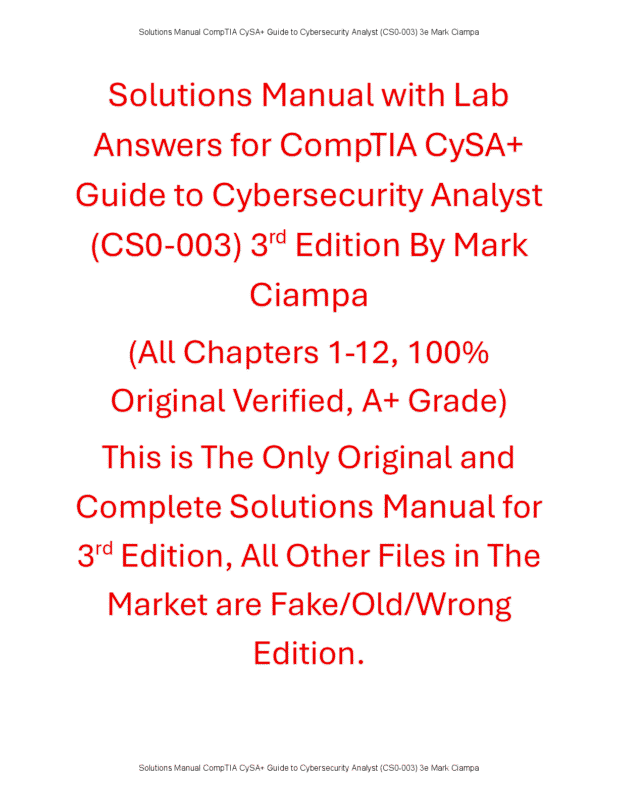
Solutions Manual for CompTIA CySA+ Guide to Cybersecurity Analyst (CS0-003) 3rd Edition By Mark Ciampa
$30.00
Secure checkout
Instant digital download
PDF document
Document details
- Pages
- 184
- File size
- 2.12 MB
- Format
- Digital PDF
- Course
- Computer Architecture
- Category
- SOLUTIONS MANUAL
Sign in or create a free account to continue. Your purchase will be saved in My Downloads.
About this ebook
The Solutions Manual for 3rd Edition of Mark Ciampa's CompTIA CySA+ Guide to Cybersecurity Analyst is meticulously designed to directly map to the CS0-003 certification exam objectives. Published by Cengage Learning, the textbook is broken down into four core blueprint parts and includes transitional material preparing students for future iterations of the exam. [1, 2, 3, 4, 5]
The primary breakdown of topics and chapters covered in this edition includes:
Part 1: Cybersecurity Foundations
This introductory section establishes the underlying framework necessary for active defense operations and threat mechanics. [1]
- Technology Underpinnings: Deep dive into networks, protocols, and infrastructural architecture basics.
- Threat Actors and Their Threats: Explores attacker motivations, profiles, vectors, and contemporary malware variants.
- Cybersecurity Substrata: Defensive structural layers, controls, and baseline security frameworks.
- Note: This section uniquely features "Level Up to the CompTIA CySA+ CS0-004 Certification Exam" transition checkpoints to prep readers for upcoming industry shifts. [1, 2, 3]
Part 2: Security Operations
This domain focuses on real-time log ingestion, traffic monitoring, and behavior analysis. [1, 2, 3, 4]
- Identifying Indicators of Attack (IOA): Spotting real-time adversarial maneuvers before breaches occur. [1, 2]
- Analyzing Indicators of Compromise (IOC): Post-incident evidence identification using SIEM systems, firewall records, and threat intelligence. [1, 2]
- Threat Detection and Process Improvement: Fine-tuning detection engineering workflows and utilizing artificial intelligence/data analytics. [1, 2, 3]
Part 3: Vulnerability Assessment and Management
This module centers on identifying, ranking, and mitigating technical weaknesses inside an enterprise perimeter. [1, 2]
- Vulnerability Scanning and Assessment Tools: Practical usage of automated configuration and system scan tools.
- Addressing Vulnerabilities: Selecting proper responses, including remediation, mitigation, or risk acceptance.
- Vulnerability Management Reporting and Communication: Crafting actionable metrics for stakeholders and technical staff. [1, 2, 3]
Part 4: Incident Response Management
This section walks through the complete lifecycle of a live security breach from identification to post-mortem analysis. [1, 2, 3, 4]
- Incident Response Planning: Standard Operating Procedures (SOPs), team compositions, and playbook creation.
- Responding to a Cyber Incident: Containment, eradication, recovery, and digital forensics strategies.
- Data Protection and Utilization: Data sovereignty rules, compliance criteria, and secure asset decommissioning. [1, 2, 3, 4, 5]
File included
tmpphp2Hh97A
2.12 MB
Related ebooks