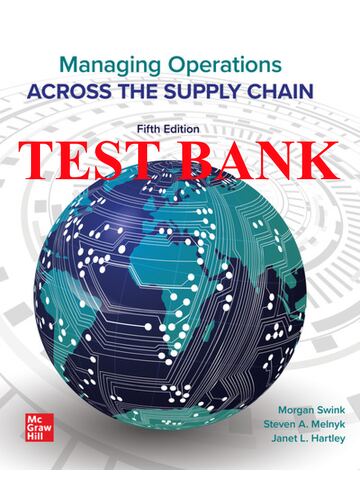
TEST BANK for Managing Operations Across the Supply Chain, 5th Edition Morgan by Swink, Melnyk, Hartley | Includes Answers to Discussion Questions
$26.00
Secure checkout
Instant digital download
PDF document
Document details
- Pages
- 1,070
- File size
- 11 MB
- Format
- Digital PDF
- Course
- Management
- Category
- TEST BANKS
Sign in or create a free account to continue. Your purchase will be saved in My Downloads.
About this ebook
The TEST BANK for Managing Operations Across the Supply Chain 5th Edition by Morgan Swink, Steven Melnyk, and Janet L. Hartley provides an integrated, global perspective on operations management. The textbook breaks away from purely internal warehouse tracking and frames every decision through a cross-functional supply chain network. [1, 2, 3, 4]
The book is structured into four major parts across 14 chapters and includes dedicated analytical supplements. [1]
🌐 Part 1: Supply Chain: A Perspective for Operations Management
This introductory segment establishes how operational goals must tie directly to high-level corporate strategies. [1]
- Chapter 1: Introduction to Managing Operations Across the Supply Chain – Explores the baseline differences between goods and services, process thinking, and the historical evolution of modern supply chain networks. [1]
- Chapter 2: Operations and Supply Chain Strategy – Covers competitive priorities, identifying core capabilities, strategic alignment, and designing product-service bundles. [1, 2, 3]
🏗️ Part 2: Foundations of Operations Management
This core section tackles internal day-to-day execution, process designs, and baseline asset management. [1]
- Chapter 3: Managing Processes and Capacity – Discusses processing limits, bottlenecks, and utilization metrics.
- Chapter Supplement: Process Mapping and Analysis – Practical frameworks for visual workflow optimization. [1]
- Chapter 4: Product/Process Innovation – Strategies for integrating product design cycles with manufacturing realities. [1]
- Chapter 5: Manufacturing and Service Process Structures – Focuses on layout configurations, mass customization, and service blueprinting. [1, 2]
- Chapter 6: Managing Quality – Evaluates total quality management (TQM) philosophies, Six Sigma, and cost-of-quality frameworks.
- Chapter 7: Managing Inventories – Deep-dives into safety stock, economic order quantity (EOQ) formulations, and independent vs. dependent demand. [1, 2]
- Chapter 8: Lean Systems – Eliminating waste, continuous flow management, and just-in-time (JIT) scheduling paradigms. [1]
🤝 Part 3: Integrating Relationships Across the Supply Chain
This part extends beyond the firm's walls to manage immediate upstream and downstream external partnerships. [1]
- Chapter 9: Customer Service Management – Establishing service metrics, lead-time expectations, and customer satisfaction tracking.
- Chapter 10: Sourcing and Supply Management – Strategic procurement, vendor evaluation matrices, and supplier relationship management.
- Chapter 11: Logistics Management – Network design, physical distribution, warehousing strategies, and multi-modal transportation systems. [1, 2]
🗓️ Part 4: Planning for Integrated Operations Across the Supply Chain
The final section covers the computational, predictive models used to align product availability with volatile market needs. [1]
- Chapter 12: Demand Planning: Forecasting and Demand Management – Explores quantitative/qualitative forecasting formulas and push-vs-pull inventory systems. [1, 2]
- Chapter 13: Sales and Operations Planning (S&OP) – Strategies for cross-departmental tactical alignment to balance corporate capacity against incoming orders. [1]
- Chapter 14: Materials and Resource Requirements Planning (MRP) – Teaches Bill of Materials (BOM) management, inventory records explosion, and basic ERP platform dynamics. [1, 2]
🔄 Key Modern Updates Featured in the 5th Edition
If you are upgrading from an older version, the authors specifically injected several contemporary themes into these topics: [1]
- Digital Transformation: Expanded focus on digital kiosks, automated tracking tools, and modern data processing.
- Resilience Frameworks: Case studies dealing directly with labor shortages, shipping backlogs, and post-COVID-19 ecosystem adjustments.
- Sustainability & Risk: Green logistics, ethical sourcing practices, and environmental regulations wrapped tightly into standard operations decisions. [1, 2]
File included
TEST-BANK-for-Managing-Operations-Across-the-Supply-Chain-5th-Edition-Morgan-by-Swink-Melnyk-Hartley.pdf
11 MB
Related ebooks