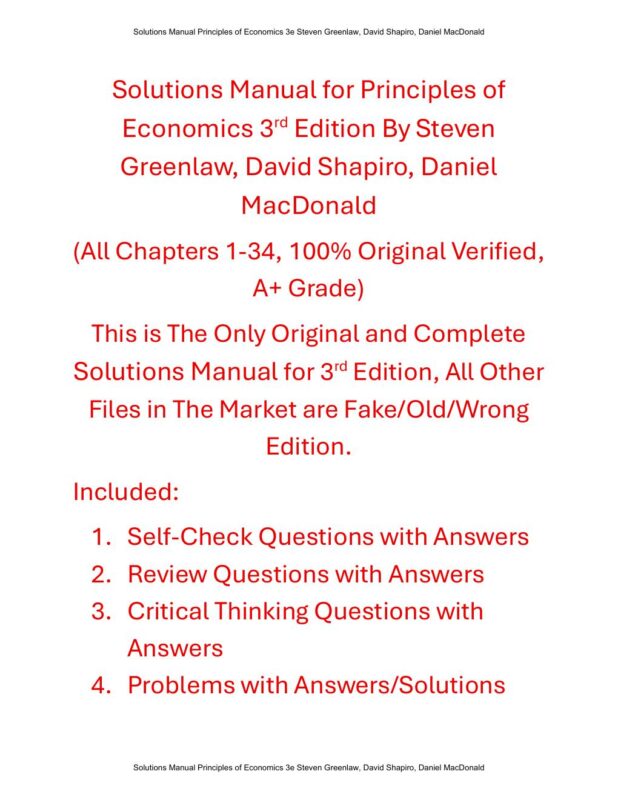
Solutions Manual for Principles of Economics 3rd Edition By Steven Greenlaw, David Shapiro, Daniel MacDonald
$30.00
Secure checkout
Instant digital download
PDF document
Document details
- Pages
- 331
- File size
- 2.59 MB
- Format
- Digital PDF
- Course
- Economics
- Category
- SOLUTIONS MANUAL
Sign in or create a free account to continue. Your purchase will be saved in My Downloads.
About this ebook
Solutions Manual for Principles of Economics 3rd Edition by Steven A. Greenlaw, David Shapiro, and Daniel MacDonald (published by OpenStax) is a comprehensive introductory textbook comprising 34 chapters. It provides a balanced approach covering core theories and real-world policy applications across both microeconomics and macroeconomics. [1, 2]
The primary topics and structural sections covered in the textbook include:
1. Introduction to Economic Thinking (Chapters 1–2)
- What is Economics?: Scarcity, the economic way of thinking, and the division and specialization of labor.
- Economic Systems: Descriptions of traditional, command, market, and mixed economies, alongside globalization.
- Choice in a World of Scarcity: Trade-offs, budget constraints, production possibilities frontier (PPF), opportunity costs, and marginal analysis. [1, 2, 3]
2. Core Market Mechanisms (Chapters 3–5)
- Demand and Supply: Market equilibrium, price floors, price ceilings, and factors causing shifts in demand and supply.
- Labor and Financial Markets: Applications of supply and demand frameworks specifically to wages and financial capital investments.
- Elasticity: Price elasticity of demand and supply, cross-price elasticity, and polar cases of elasticity. [1, 2, 3, 4, 5]
3. Fundamentals of Microeconomic Theory (Chapters 6–10)
- Consumer Choice: Utility maximization, behavioral economics, and the impact of price changes on consumer options.
- Production, Costs, and Industry Structure: Explicit/implicit costs, short-run vs. long-run production, and economies of scale.
- Market Structures: Perfect competition, monopoly, monopolistic competition, and oligopoly.
- Game Theory: Strategic behavior and business decision-making frameworks. [1, 2, 3, 4, 5]
4. Microeconomic Policy Issues (Chapters 11–18)
- Market Failures: Positive and negative externalities, environmental protection, public goods, and the tragedy of the commons.
- Government Intervention: Antitrust policy, corporate mergers, deregulation, and regulation of natural monopolies.
- Labor & Inequality: Poverty lines, income inequality causes, labor unions, and discrimination in employment.
- Risk & Finance: Financial markets, asymmetric information, and insurance. [1, 2, 3]
5. Macroeconomic Perspective and Goals (Chapters 19–23)
- Macroeconomic Objectives: Measures of economic growth, Gross Domestic Product (GDP), and business cycles.
- Unemployment: Types of unemployment (frictional, structural, cyclical) and measurement challenges.
- Inflation: The Consumer Price Index (CPI), historical trends, and economic impacts of inflation.
- Trade and Capital Flows: The balance of trade, current account balances, and national saving/investment identities. [1, 2, 3, 4, 5]
6. Frameworks for Macroeconomic Analysis (Chapters 24–26)
- The AD/AS Model: Aggregate Demand and Aggregate Supply shifts and equilibrium.
- The Keynesian Perspective: Demand-driven economics, sticky wages, and the multiplier effect.
- The Neoclassical Perspective: Supply-driven economics, flexible prices, and long-run potential GDP. [1, 2, 3]
7. Monetary and Fiscal Policy (Chapters 27–31)
- Money and Banking: The definition of money, banking ecosystems, and money creation mechanisms.
- The Federal Reserve and Monetary Policy: Interest rates, open market operations, and quantitative easing.
- Fiscal Policy: Government spending, taxation, federal budget deficits, and national debt. [1, 2]
8. International Economics (Chapters 32–34)
- International Trade: Absolute and comparative advantage, specialization, and gains from trade.
- Globalization and Protectionism: Tariffs, import quotas, non-tariff barriers, and trade policies.
- Exchange Rates: Foreign exchange markets, floating vs. pegged currencies, and international financial crashes. [1, 2]
File included
tmpphpuOHikT
2.59 MB
Related ebooks